



Artificial Intelligence is changing the world around us, from self-driving cars to Google maps predicting traffic. If you’re preparing for a job interview in the AI field, understanding AI concepts is super important.
This page is designed to help you get ready by providing common AI-related questions you might face, along with brief, easy-to-understand answers. Whether you’re new to AI or brushing up on your skills, these questions cover wide range of topics like machine learning, neural networks, and AI ethics for a deeper understanding of concepts.
Our experts have made sure the answers are well-written so you can feel confident learning and rehearsing from them. Use this interview guide to practice, learn important concepts, and understand how to give answers. Let’s get one step closer to acing your AI interview!
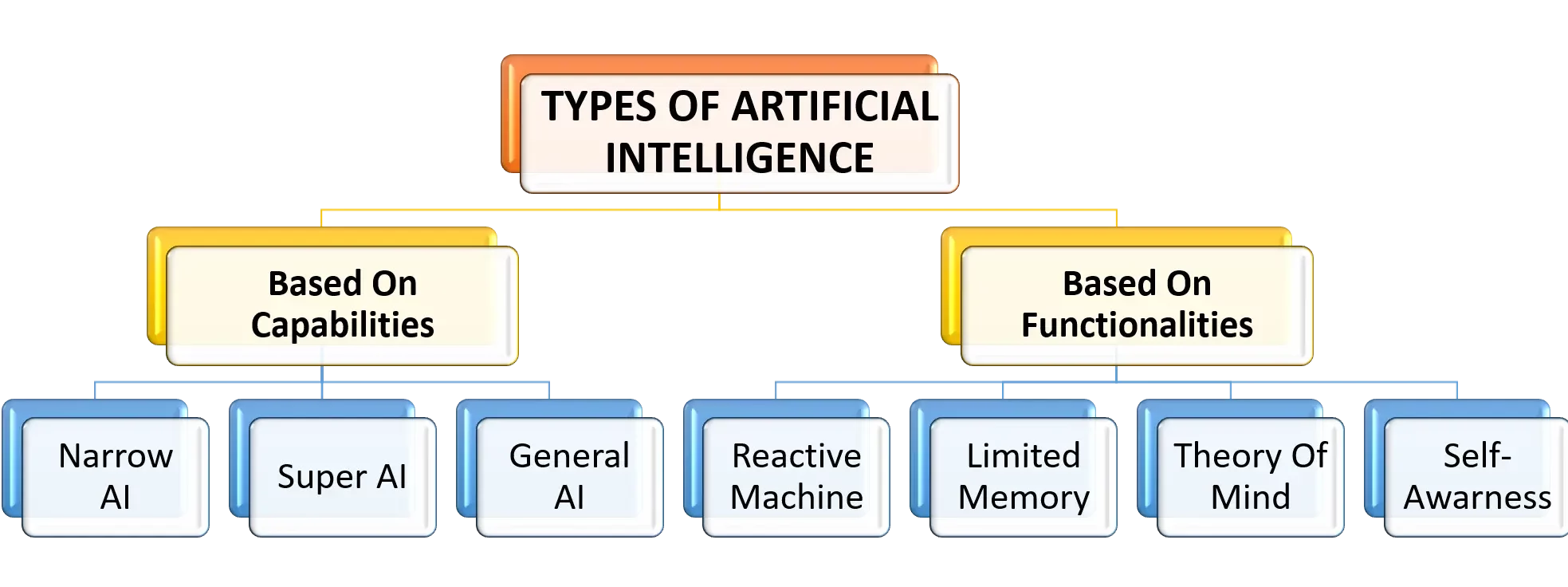
- Weak AI or Narrow AI: These are designed to perform dedicated tasks. They cannot perform beyond their capabilities. Apple’s Siri and IBM’s Watson are some examples of weak AI or narrow AI.
- General AI: General AI can perform any intellectual task like humans. Currently, there is no system in the world that can be categorized under general AI. Researchers, however, are focused on developing AI devices that can perform tasks as perfectly as humans.
- Super AI: Super AI is the level of Artificial Intelligence at which it can pass the intelligence of humans and can perform tasks better than humans. Super AI is still a hypothetical concept.
- Reactive Machines: These kinds of machines react in the best possible way in a current situation. They do not store memories or experiences. IBM’s Deep Blue system and Google’s Alpha go are some examples of reactive machines.
- Limited memory: These machines store experiences, but only for a limited amount of time. For example, smart cars store the information of nearby cars, their speed, speed limit, route information for a limited amount of time.
- Theory of mind: The theory of machine AI is a theoretical concept. They might be able to understand human emotions, beliefs, society, and might be able to interact like humans.
- Self-awareness: Self-awareness AI is the future of AI. It is expected that these machines will be super-intelligent, having their own consciousness, emotions, and self-awareness.
- Strong AI is a theoretical form of AI with a view that machines can develop consciousness and cognitive abilities equal to humans. Weak AI, also called narrow AI, is AI with limited functionality. It refers to building machines with complex algorithms to accomplish complex problem-solving, but it does not show the entire range of human cognitive capabilities.
- Strong AI can perform a wide range of functions. In comparison to strong AI, weak AI has fewer functions. Weak AI is unable of achieving self-awareness or demonstrating the full spectrum of human cognitive capacities and operate within a pre-defined range of functions.
- Strong AI-powered machines have a mind of their own, and they can think and accomplish tasks on their own. While, Weak AI-powered machines do not have a mind of their own.
- No machine of strong AI exists in reality. Examples include Siri or Google Assistant.
- Simple Reflex Agents: Simple reflex agents ignore the history of the environment and its interaction with the environment and act entirely on the current situation.
- Model-Based Reflex Agents: These models perceive the world according to the predefined models. This model also keeps track of internal conditions, which can be adjusted according to the changes made in the environment.
- Goal-Based Agents: These kinds of agents react according to the goals given to them. Their ultimate aim is to reach that goal. If the agent is provided with multiple-choice, it will select the choice that will make it closer to the goal.
- Utility-based Agents: Sometimes, reaching the desired goal is not enough. You have to make the safest, easiest, and cheapest trip to the goal. Utility-based agents chose actions based on utilities (preferences set) of the choices.
- Learning Agents: These kinds of agents can learn from their experiences.
- Backward Chaining: It starts with the end aim and then works backward to figure out the evidence that points in that direction.
- Forward Chaining: It begins with facts that are already known and then claims new facts.