Every job seeker dreams of working from home. No morning commute, the flexibility to balance life and work, and the chance to wear casuals all day. But this enticing opportunity turns into a nightmare for job seekers who fall victim to scam remote jobs. As companies are laying off people, online job scams have also risen. Read the different kind of Job Scams and how to avoid Job Scams.

The scammers are exploiting innocent job seekers, giving them hope of a high-paying job. The Federal Trade Commission (FTC) stats reveal that between 2020 and 2023, there was a threefold increase in the money lost to job scams. In just the first six months of 2024, people lost over $220 million to these tricky scams.
If you are looking for a job, it’s very important to know how to spot and avoid job scams. Read this blog to understand which jobs are legitimate and how to protect your financial and personal information from scammers.
What Are Remote Job Scams?
Remote job scams are fake jobs created with the intention of deceiving people who want to work from home. Scam jobs offer high salaries, easy tasks, and flexible hours, and require no skills, experience, or degree. Basically, these jobs look like dream jobs anyone would go for instantly, but in reality, they are a trap. Scam jobs trick you into sharing your personal information like bank details, social security numbers, etc., and even get you tangled in illegal activities.
As these scams have a very convincing setup, like they will have professional job postings, emails, or even fake interviews, desperate job seekers easily become victims of such scams.
Common Types of Remote Job Scams
Job scams are of different types, but they all have the same purpose: to cheat gullible job seekers. Here are five common remote job scams, with examples to help you recognize them:
- Fake Job Postings: These are job listings that look real but lead nowhere. Scammers might use a well-known company’s name or create a fake one to trick you into sharing personal details . Data entry jobs are a good example of how job seekers become victims of false job promises.
- Phishing Emails: A random email offering you a dream remote job is a common job scam. The email might include a link to apply or an attachment with job details. Clicking the link or opening the file could install malware or lead to a fake website that steals your data.

- Pyramid Schemes: These scams promise big earnings for minimal work, but the catch is that you need to sign up more people or sell products to make money. They often require upfront payments for training or inventory.
- Fake Survey Jobs: Scammers offer quick money for completing online surveys, but they often ask for a fee to access “exclusive” survey lists or premium opportunities. In reality, you either get nothing or low-paying surveys that don’t cover the cost.
- Reshipping Scams: These scams involve “jobs” where you receive packages at home and ship them elsewhere. While this may look simple, the packages often have stolen items, and you could get into legal trouble. In addition, scammers may never pay you and worse, ask you to cover shipping costs.
- Fake Check Scam : In a fake check scam, the person giving the Job offer will send you a check and ask you to deposit it . They will say its for buying Laptop, computer, phone, Internet etc. It’s usually for more than they owe you, and it’s sometimes for several thousand dollars. Then they will say by mistake they sent you more than they should have sent and ask you to wire or send the balance back through Gift cards or They tell you to send some of the money back to them or to another person. It takes time as much as 2-3 weeks for banks to verify a check’s validity. Scammers use this time to pressure you into sending money before the check is discovered to be fake. Later after 203 weeks the check bounces and the money credited into your account will de deducted from your balance.
Red Flag to Watch For
The only way you can protect yourself from job scams is by identifying them. Here are some red flags you must watch out for when searching for jobs.
Too-Good-to-Be-True
If a job offers high pay for little effort or no experience, it’s most likely a trap. Legitimate remote jobs require skills, experience, and commitment, just like in-person roles. For instance, a posting claiming you’ll earn $5,000 a month for 10 hours of weekly typing work with no qualifications is a major red flag.
Quick Hiring
Hiring is a complex process with multiple rounds, even for fresher-level jobs. So, if you apply for a job and are hired after a few basic questions on chat, you are most likely in a scam. The scammers make the job process look seamless and ensure you get overwhelmed by saying things like, you’re the best, glad to have you, etc. Feel suspicious if there is no pushback and real assessment, just instant praise.
Vague or Missing Company Details
A real company will have a clear online presence—a website, verified contact info, and reviews from employees or customers. If the job listing lacks a company name or only provides a generic email, dig deeper or completely avoid it.
Poor Communication
Companies, small or big, communicate clearly and professionally. Watch out for badly written emails or messages in broken English or with inconsistent details. For example, an email that has errors or is sent from a Gmail or Outlook account instead of a company domain is suspicious. Today, even small companies have emails like @companyname.net.
Not Addressed To You
Usually, scammers send bulk emails to a large number of people. So, when you get a scam job offer, you will never see your name in it. It will not be addressed to you or will not have any signatures on it.
Requests for Sensitive Information
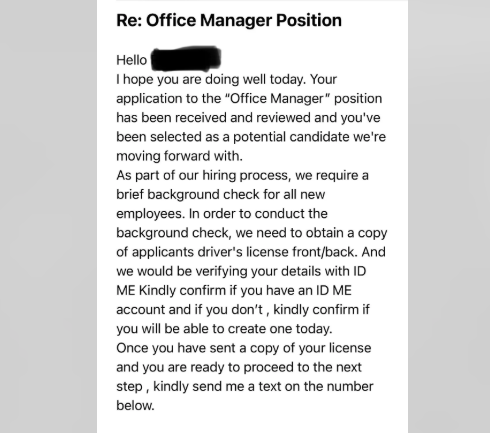
Reputed employers don’t ask for your Social Security number, bank details, or credit card info during the initial application process. If a “recruiter” asks for sensitive information before a job offer, it’s a scam. Look at the following message.
Upfront Payments
No real job requires fees to apply or start. If you’re asked to shell out money for computers, phone, any equipment or background checks, it’s a scam. Real employers don’t charge for anything they provide.
How to Protect Yourself from Remote Job Scams?
Now that you know what to look for, let’s talk about practical steps to and learn hot to avoid Job scams while hunting for remote work.
Never Pay for a Job
If a job asks for money upfront for equipment, or registration, run! For example, a job that requires you to pay for a software package or some equipment to start it’s certainly a scam.
Check the Domain in the email ID
Always check the complete email id. Mostly Scammers would try to either use a similar domain name like the company to trick. For ex: name@synergisticit.com is an actual email however a scammer may use name@synergisticitcareers.com or name@synergisticlt.com or use synergisticitcareer@gmail.com. Always copy the domain after the @ and see if it opens the actual company website if not the offer is fake. Also No Organization will send job offers over text or over gmail or personal email.
Research the Company Thoroughly
Before applying, Google the company’s name along with terms like “scam” or “reviews.” Check their official website, LinkedIn page, and Google rating. If the company doesn’t have a website or its online presence feels off, like a website with no info, proceed with caution. Always verify the company before proceeding further.
Beware of High-Pressure Tactics
Scammers often push you to act fast, claiming the job will “disappear” if you don’t sign up or pay immediately. Take time to research, think through, and verify information. A real employer will give you time to consider an offer. If you feel you are pressured like a recruiter insisting that you sign the contract within the deadline or lose the opportunity, it’s best to step back.
Verify Salary Expectations
Research the salary range for the role you’re applying for. You will get the salary details easily on sites like Glassdoor or PayScale. If the pay mentioned seems unusually high for the work or experience required, it’s a warning sign. For example, a remote “transcriptionist” job offering $80,000 a year with no experience is unrealistic compared to the industry average of $30,000–$50,000.
Protect Your Personal Information
Don’t share sensitive details such as your Social Security number, bank account info, or driver’s license until you’ve verified the employer and signed a contract. If you’re asked for this early, politely decline and ask for more details about the hiring process.
Do not Accept Checks as Payment for Buying any Equipment.
Scammers will send checks and ask to deposit them and send them the excess money back to them. In such a Scenario if asked to deposit check ask them to buy the equipment online and ship directly to your address.
Use Trusted Job Platforms
Stick to reputable job boards, like LinkedIn, Indeed,
Monster, or FlexJobs, which have measures to filter out scams. In addition, verify listings by checking the company’s official website. Avoid applying through random emails or sketchy websites. For instance, if you see a job on Indeed, cross-check it on the company’s career page.
Trust Your Instincts
If something feels off, it probably is. Maybe the recruiter’s pushy, the job sounds too perfect, or the communication is vague. Pause, research, and talk to someone you trust before moving forward.
Spotting Legitimate Remote Jobs
Job scams are discouraging and can make you feel low, but there are plenty of genuine opportunities too. Here is how you can identify genuine opportunities.
Verified by Reputable Sources
Check if the job is listed on the company’s official website or verified by organizations like the BBB. For example, if you find a remote tech support role at a company, visit their official careers page to check if it’s a real or fake posting. You can also call them and ask about the opportunity.
Clear and Professional Communication
Legitimate employers use professional language and provide clear contact information, like a company email or phone number. They will also explain the hiring process upfront. If Most of the Communication is Over Emails or text and they don’t speak to you on Phone or on a Video or In-person Interview its definitely a fake Job Offer.
Detailed Job Descriptions
Real jobs include specific details, required skills, qualifications, certifications, and desired skill sets. A posting that says “Work from home, earn big!” with no experience or skills is an outright scam. A legit one will list tasks and responsibilities, along with details, like working conditions, etc.
Structured Hiring Process
A real job might involve an application, a phone screening, and multiple interviews, including tests etc. Genuine jobs rarely offer instant hiring. Also, the offer letter is extended only after reference checks and by HR, through the company email. Most Scam Jobs will raise an offer letter within 2-3 days without even a phone screen and a Zoom Interview.
What to Do If You Spot a Scam?
If you suspect you’ve encountered a scam, act fast to protect yourself and others:
- Collect Evidence: Save emails, job postings, or any communication with the scammer. Screenshots and PDFs are the best evidence.
- Report the Scam: File a complaint with your local police, the Federal Trade Commission (FTC) in the U.S., or your country’s consumer protection agency. Include all evidence. You can also report to the BBB or the platform where you found the job, like LinkedIn or Indeed.
- Notify Your Bank: If you shared financial info, contact your bank or credit card company immediately. Ask them to monitor your accounts and freeze any suspicious activity. For instance, if you gave your card details for a “training fee,” report it as fraud.
- Secure Your Accounts: Change passwords for any accounts that might be compromised, like your email or job board profiles. Enable two-factor authentication for extra security.
- Tell Everyone: Warn others by sharing your experience on social media or job boards with the evidence. This way, you can prevent others from falling for the same scam.
Conclusion
Remote jobs are exciting and offer many benefits, but they also create an opportunity for scammers. So, it’s important to stay alert to such jobs. Research thoroughly about the company before proceeding, and try not to give sensitive information at any cost. Believe in your instinct. If a job looks better than expected, be suspicious. It’s better to wait than regret later.
Since 2010, SynergisticIT has helped 1000’s of job seekers thrive in the tech industry. At SynergisticIT, we make candidates work on technologies and skills Tech clients demand.
Our unique approach goes beyond training, offering hands-on project experience. We also have a marketing team to promote your skills, so you don’t have to. Check out our candidate outcomes page to see the success stories.
We also participate in industry events like Oracle Java One and the Gartner Data and Analytics Summit, offering excellent opportunities for brand recognition during your job search. Be sure to watch our event videos for more insights.
Furthermore, we have a vast network of clients with whom we can introduce your resume. Since we have been in business since 2010, our brand name association increases your chances of being considered by potential employers. Please visit our Transform Your Future with SynergisticIT | Candidate Outcomes page to learn how we have helped Tech job seekers and how we can jumpstart your tech career!