



The introduction of the new $100k H1 B visa filing fee marks one of the most sweeping—and controversial—shifts in U.S. immigration and tech labor policy in recent decades. Announced under the Trump Administration and widely reported across mainstream outlets such as USA Today, Forbes, and CNBC, the rule immediately sparked debate among tech companies, immigration advocates, policy makers, and the global talent pool that powers innovation across the United States.
The size of this fee, its strategic intent, and its practical consequences are matters of urgent relevance not only for foreign workers and major employers like Amazon, Apple, Google, and Microsoft but also for recent U.S. graduates seeking to enter the field via the Optional Practical Training (OPT) route, H-4 EAD visa holders, and even American tech workers facing a rapidly globalizing job market.
Crucially, the $100k fee is far from universally applicable, as several myths and misunderstandings have emerged in public discourse. Questions regarding who exactly must pay this fee, when it takes effect, and its implications for renewals, extensions, and status changes are fueling widespread uncertainty.
Alongside these nuanced questions sits the broader concern: How will this fee reverberate through the U.S. tech sector, particularly in an era in which remote work technologies make the “globalization of code” easier and more cost-effective than ever?
This blog post provides a clear, authoritative, and data-driven exploration of the $100,000 H-1B filing fee, its applicability and limitations, its impact on diverse visa holders and employers, its potential effects—intended and unintended—on the U.S. tech market, and how jobseekers can best position themselves for success in this new reality.
The $100k H-1B Filing Fee: Origin, Intent, and the Facts
Background and Proclamation Details

Key Implementation Facts: Who Pays and When?
The $100k H1 B filing fee does NOT apply to all H-1B filings, nor is it an annual recurring fee. Instead, it targets specific types of filings, largely focused on first-time H-1B petitions filed by employers for workers residing outside the United States as of the date the fee takes effect.
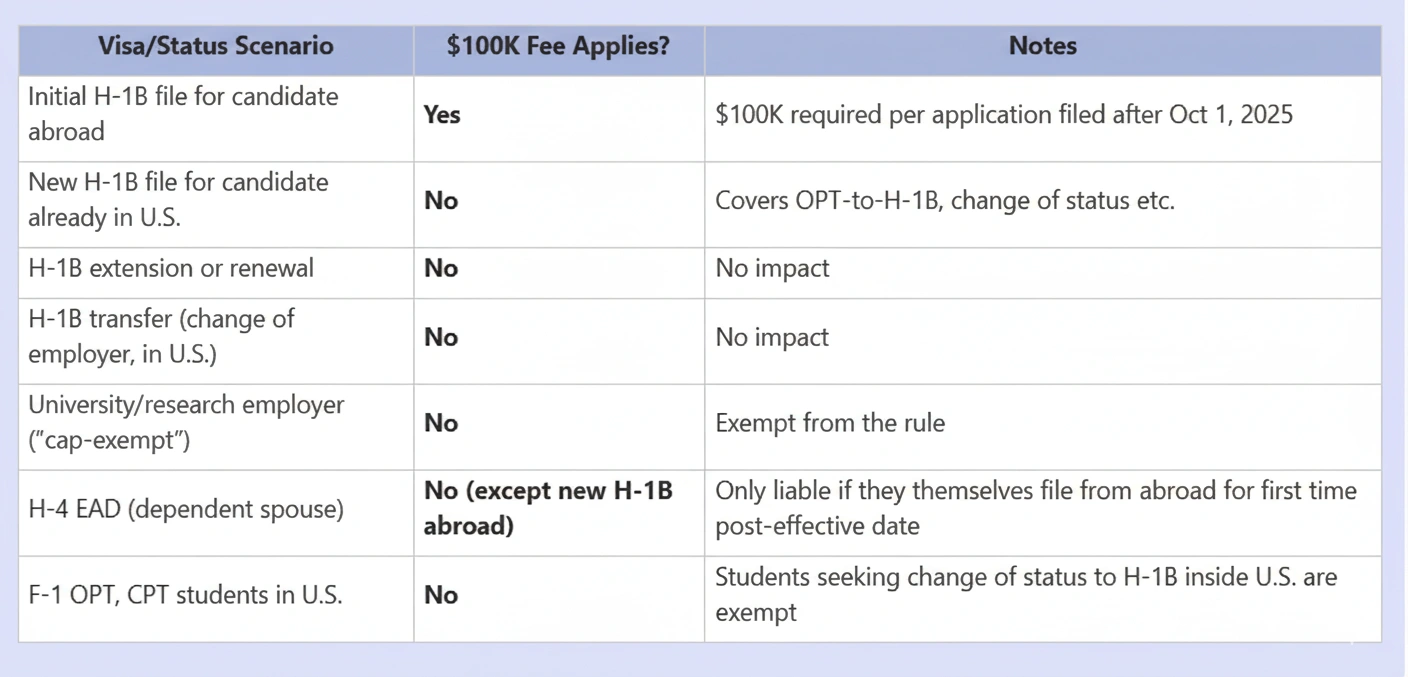
The core facts, drawn from the executive order and government agency clarifications, are summarized in the following table:
| Applicability | Covered by $100K Fee? | Details and Exceptions |
| First-time H-1B applicants abroad | Yes | Applies to new, cap-subject petitions for candidates outside the U.S. as of the effective date. |
| First-time H-1B applicants in U.S. (change of status) | No | Not applicable for OPT holders and other nonimmigrants changing status from within the U.S. |
| H-1B renewals/extensions | No | Does not apply to extension or renewal petitions for existing H-1B holders. |
| H-1B transfers (change of employer) | No | Not applicable for transfers within U.S. |
| Cap-exempt entities (universities, research) | No | Cap-exempt entities remain exempt. |
| H-4 EAD holders | No (unless filing new H-1B) | No direct impact unless seeking new H-1B status from abroad. |
| Existing H-1B holders living in U.S. | No | Existing visa holders not affected. |
| OPT holders in U.S. switching to H-1B | No | OPT to H-1B change of status (in-country) is exempt. |
Effective Date and Transition Rules
According to the proclamation and follow-up notices, the $100,000 H-1B filing fee is slated to take effect for petitions filed on or after October 1, 2025. There is no retroactive application; only filings initiated after this effective date will be subject to the new fee schedule. USCIS and DHS have indicated a short period of regulatory adjustment leading up to the implementation, but the cut-off is clear: petitions filed before October 1, 2025 are exempt.
For employers and aspiring foreign workers, this date has become a critical deadline. Many U.S. companies rush to file cap-subject petitions before the new cost structure locks in, while foreign applicants who are abroad must weigh the feasibility of alternative immigration strategies or risk the prohibitive cost.
Common Myths and Clarifications
- The $100k H1 B filing fee is annual: False—it is a one-time filing fee per initial application, not an annual recurring fee.
- Applies to existing H-1B holders: False—existing visa holders, extensions, and employer changes within the U.S. are unaffected.
- OPT/CPT students must pay: False—if changing status in-country, they are exempt.
- Fee applies to cap-exempt employers: False—universities and research institutions continue to enjoy exemptions.
Applicability: Who Is—and Is Not—Affected by the $100k H1B Filing Fee
First-Time, Abroad-Based Applicants
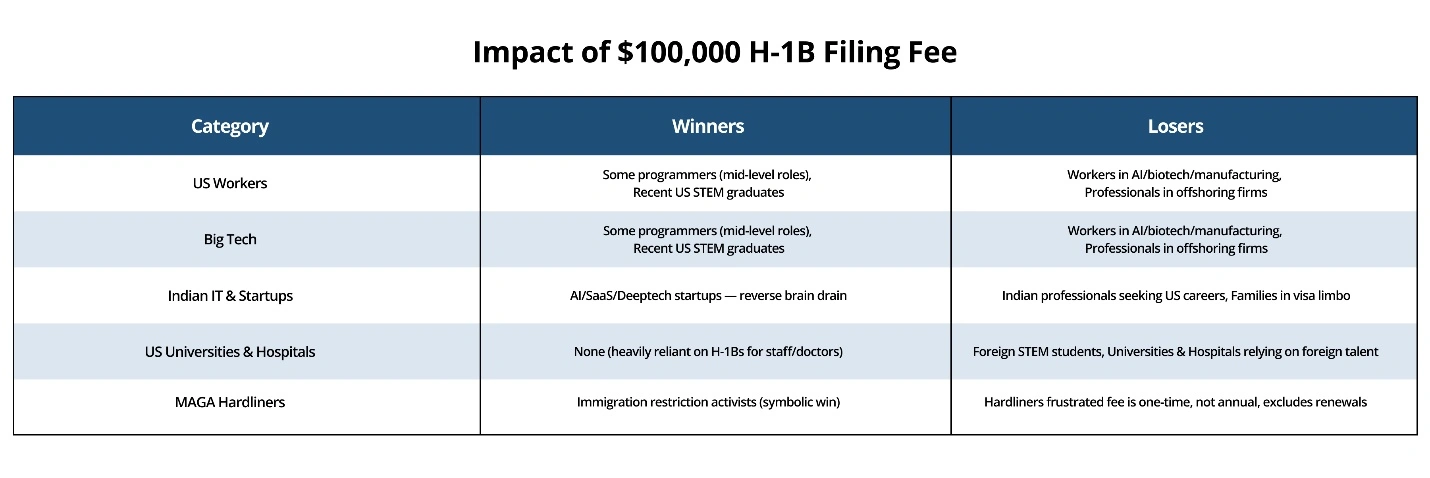
The most heavily impacted group is first-time H-1B applicants residing outside the U.S. as of the effective date. For employers, particularly large tech firms and multinational outsourcing companies accustomed to recruiting overseas and staffing new hires into American projects via visa sponsorship, the new fee represents a dramatic, potentially deal-breaking increase in the cost of each overseas hire.
Given the cost, this essentially limits new H-1B filings from abroad to only the highest-demand, highest-value candidates, or to instances in which no suitable U.S.-based applicant (citizen or green card holder) is available.
In-Country Change of Status (OPT to H-1B Etc.)
Candidates who are already lawfully present in the U.S. (such as those on F-1 Optional Practical Training, Curricular Practical Training, or other nonimmigrant categories) and whose employers file for a change of status to H-1B are NOT subject to the $100k H1 B filing fee. This is a critical distinction for international graduates of U.S. universities, who have typically transitioned from OPT to H-1B visas in the tech industry cycle.
This provision recognizes the investment and integration these foreign graduates have already made in the U.S. education and labor markets, distinguishing them from applicants residing abroad who have not yet contributed to the domestic skill pool.
H-1B Extensions, Renewals, and Transfers
The $100k H1 B filing fee does not apply to H-1B extensions (renewals) or transfers (change of employer) for individuals already on H-1B status within the United States. This is highly relevant for companies retaining existing talent, and for workers who seek to move between employers or simply renew their lawful status. The stated policy rationale is to avoid penalizing talent retention or continuity and to focus the fee on new market inflows.
Cap-Exempt Employers
H-4 EAD Holders and Their Employers
OPT, CPT, and Other Nonimmigrant Student Visa Holders
Impact Across Major Visa Categories and Scenarios
Ramifications for U.S. Tech Employers: Offshoring, Outsourcing, and Workforce Restructuring
The Business Reaction: Offshoring and Outsourcing as Economic Responses
| Rank | Employer | H-1B Approvals | Industry |
| 1 | Amazon.com Services LLC | 10,044 | E-commerce & Cloud Computing |
| 2 | Tata Consultancy Services Limited (TCS) | 5,505 | IT Services & Consulting |
| 3 | Microsoft Corporation | 5,189 | Technology & Software |
| 4 | Meta Platforms Inc | 5,123 | Social Media & AI |
| 5 | Apple Inc | 4,202 | Consumer Electronics & Software |
| 6 | Google LLC | 4,181 | Technology & AI |
| 7 | Cognizant Technology Solutions | 2,493 | IT Services & Consulting |
| 8 | JPMorgan Chase & Co | 2,440 | Finance & Banking |
| 9 | Walmart Associates Inc | 2,390 | Retail & Technology |
| 10 | Deloitte Consulting LLP | 2,353 | Management & IT Consulting |
Source: US Citizenship Immigration Services
Economic analyses from outlets such as Outlook Business and Forbes have articulated how such an astronomical fee will:
- Drive companies to accelerate offshoring of project delivery, as the cost of bringing talent to the U.S. becomes prohibitive.
- Encourage greater reliance on global delivery centers—for example, staffing engineering and development teams in India, Eastern Europe, or Latin America rather than in the U.S.
- Shrink “bench” hiring (hiring extra foreign workers in anticipation of assignments), as the upfront cost eliminates speculative recruiting.
- Incentivize the search for remote excellence, leveraging remote work technologies to fill skills gaps from afar instead of via relocation.
Use and Impact of Remote Work Technologies
- Zoom: With over 300 million daily meeting participants, it serves as an essential tool for real-time collaboration across borders.
- Microsoft Teams: Deeply integrated with Microsoft’s productivity suite, Teams supports both synchronous and asynchronous collaboration for enterprise scale.
- Google Meet: Highly used in tech startups, Google Meet’s browser-based features facilitate quick onboarding of global contractors.
- Cisco Webex: Long a mainstay for large corporations and secure meetings, enabling high-fidelity transnational exchanges.
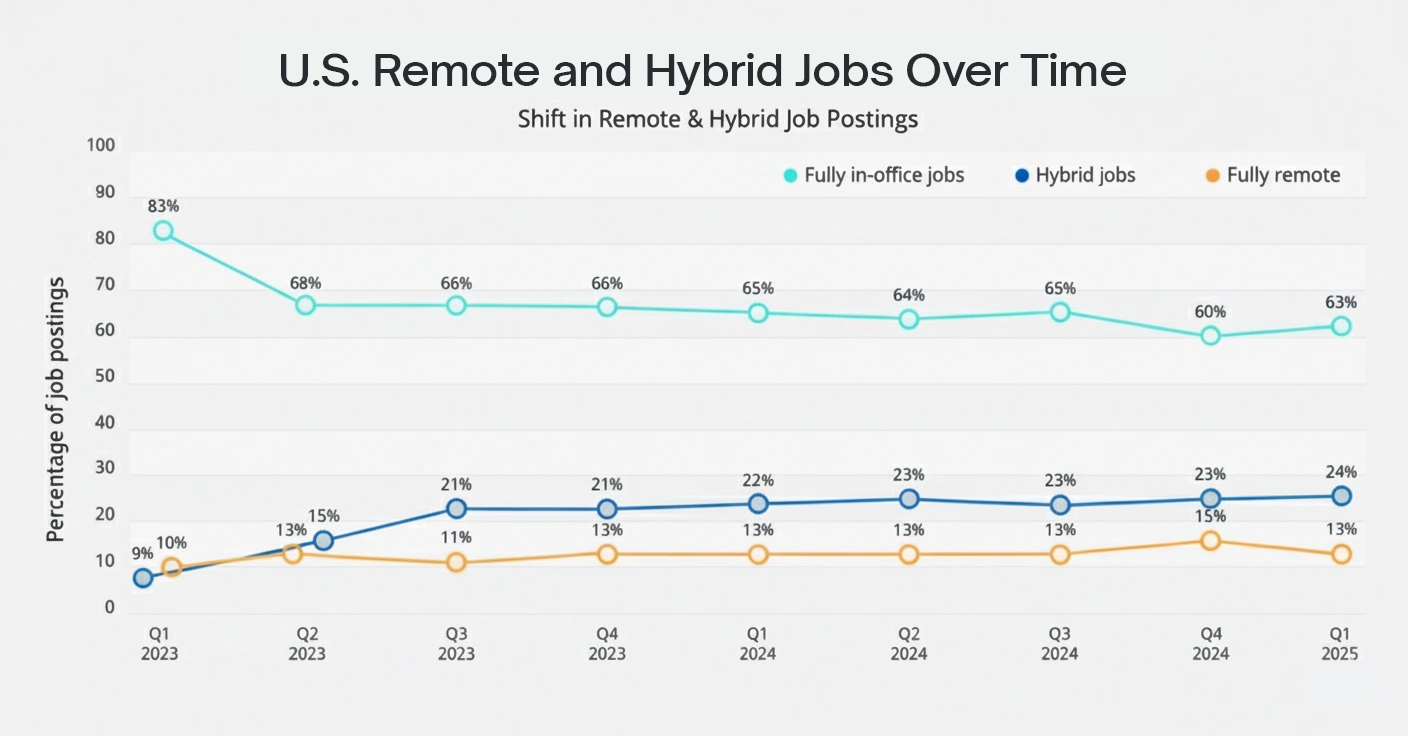
These tools mean talent acquisition is no longer geographically constrained. If regulatory or economic barriers preclude hiring foreign tech workers to physically relocate to the U.S., the same workers can remain abroad, contributing “remotely” to U.S. projects at lower cost and with minimal regulatory burden. For many firms, especially those facing fierce cost pressures, offshoring becomes not just feasible but strategically attractive.
Tech Companies’ Reliance on H-1B Workers
- About 23% of all H-1B visas go to tech companies, with information technology and business consulting comprising the lion’s share.
- Tata Consultancy Services (TCS) has been the top recipient, with over 15,000 H-1B visas approved annually in peak years.
- Other major beneficiaries include Infosys, Cognizant, Amazon, Microsoft, Google, and Apple, each sponsoring thousand of H-1B hires annually.
- At top Silicon Valley firms like Google, Amazon, Microsoft, and Meta, international employees constitute 15-25% of the tech workforce, much of this on H-1B or related visas.
| Cap Fiscal Year | Total Registrations | Eligible Registrations* | Eligible Registrations for Beneficiaries with No Other Eligible Registrations | Eligible Registrations for Beneficiaries with Multiple Eligible Registrations | Selected Registrations |
| 2021 | 274,237 | 269,424 | 241,299 | 28,125 | 124,415 |
| 2022 | 308,613 | 301,447 | 211,304 | 90,143 | 131,924 |
| 2023 | 483,927 | 474,421 | 309,241 | 165,180 | 127,600 |
| 2024 | 780,884 | 758,994 | 350,103 | 408,891 | 188,400 |
| 2025 | 479,953 | 470,342 | 423,028 | 47,314 | 135,137 |
| 2026 | 358,737 | 343,981 | 336,153 | 7,828 | 120,141 |
Source: U.S. Citizenship and Immigration Services These numbers underscore just how deeply the U.S. tech engine has relied—especially for niche skills, rapid scaling, and legacy system migration—on global human capital recruited through H-1B sponsorship.
Will the $100,000 Fee Open Jobs for American Workers?
Despite the rhetoric surrounding the policy, evidence suggests the $100k H1 B filing fee will have only a minimal impact on creating tech employment for American citizens and permanent residents. The core issue, as repeatedly noted in White House, DHS, and Business roundtable analyses, is the persistent shortage of high-end, niche tech skills within the current U.S. workforce.
Even with a sharp reduction in new overseas H-1B petitions, many U.S. tech jobs remain unfilled due to lack of qualified domestic candidates—a trend that has persisted for over a decade. The U.S. Chamber of Commerce, for instance, reports that nearly 1 million IT positions go unfilled each year due to the mismatch between workplace demands and available trained labor. Job roles in AI/ML, cloud computing, DevOps, cybersecurity, and data science remain particularly hard to fill.
The likely result, most industry experts agree, is that the new fee simply drives employers to relocate those jobs offshore, where talent can be accessed at lower friction, rather than converting them to domestic opportunities.
The New Global Tech Labor Market: Why Skill Competitiveness is Essential
The Message for American and International Tech Workers
Top Tech Skills in Demand (2025 and Beyond)
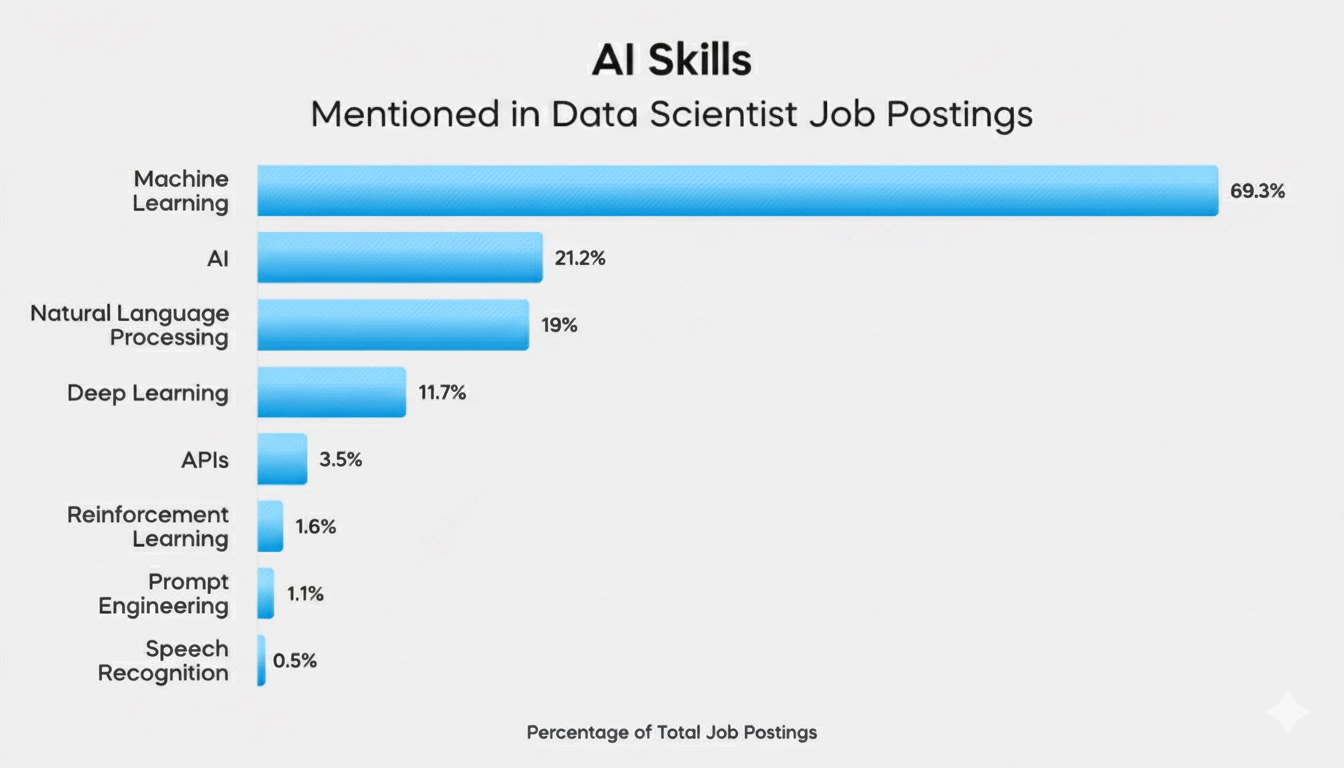
Based on up-to-date analyses from Pluralsight, Rigor Data Solutions, and other industry trackers, the skills most likely to get tech workers hired in today’s environment include:
- Cloud expertise: AWS, Azure, Google Cloud Platform.
- AI/ML: TensorFlow, PyTorch, cloud-based ML services.
- Full Stack Development: JavaScript, React, Angular, Vue.js, Node.js.
- DevOps: Docker, Kubernetes, Jenkins, CI/CD pipelines.
- Data Engineering/Science: SQL, Python, R, Apache Spark.
- Cybersecurity: SOC tools, threat modeling, penetration testing.
- Agile Methodologies & Collaboration: Jira, Git, Scrum/Agile frameworks.
Remote Work & the Reality of Global Competition
How SynergisticIT Helps Jobseekers Become Hirable: Upskilling, Real-World Readiness, and Career Placement
In a landscape shaped by stringent visa rules, global competition, and rapid technological change, finding a pathway to sustained tech employment requires more than a static degree. It demands the continuous acquisition of in-demand skills, portfolio projects, certifications, and—critically—support in navigating the interview and placement process. This is where SynergisticIT’s job placement programs stand out.
Overview: SynergisticIT’s Job Placement ProgramSynergisticIT is a well-regarded tech skills and job placement accelerator headquartered in California. Its mission is to bridge the gap between theoretical computer science education (often delivered in U.S. colleges and universities) and the “work readiness” required by leading tech employers. The program is tailored to both domestic and international jobseekers, including those coming off F-1 OPT, H-4 EAD, and other statuses.
Key features include:
- Intensive upskilling in the most in-demand technologies.
- Project-based learning mimicking real-world developer environments.
- Certification preparation and credentialing support.
- Career placement services including resume workshops, mock interviews, and guaranteed interview slots with hiring partners.
- Hands-on coaching for both technical and behavioral interviews.
SynergisticIT’s Java and Full Stack Developer Job Placement
- Curriculum covering the latest Java frameworks (Spring, Hibernate).
- Full-stack skills (JavaScript, React, Node.js).
- Integrated DevOps and automation training.
- Portfolio build-out with live, production-quality projects.
- Group learning, networking, and direct interview placement.

SynergisticIT Data Science Job Placement
- Python, R, SQL, data engineering pipelines.
- AI/ML workflows (scikit-learn, TensorFlow).
- Data visualization and BI stack coverage.
- End-to-end portfolio projects mirroring real hiring manager needs.
- Career coaching and placement with partner companies.
Resources to Excel: Interview Question Pages, Event Videos, and Blogs
- Interview Questions: See SynergisticIT’s Interview Question Page for sample coding, behavioral, and system design queries.
- Jobseekers’ Events, Seminar Recordings, and Testimonials: Visit SynergisticIT’s YouTube Channel for event videos, and Gallery for in-program highlights.
- Job-Hunting Techniques and Career Blogs: Access the Job-Hunting Techniques guide, as well as extensive blogs for jobseekers discussing career pivots, trends, and placement wins.

Success Stories and Outcomes
Industry and Media Commentary: Analysis from USA Today, Forbes, and CNBC
- USA Today recaps the announcement and highlights Silicon Valley’s concern that the policy could “cripple” the U.S. innovation pipeline by making it too costly to hire desperately needed talent, particularly in high-tech, AI, and cybersecurity sectors.
- Forbes and CNBC provide in-depth analysis of which companies are hit hardest, with special focus on outsourcing giants and their diminished bench strategies, alongside commentary from immigration law specialists about exceptions and loopholes to the fee.
- Newsweek reports that despite the intention to open jobs for U.S. workers, the net result is more likely to be offshoring than domestic hiring, as outlined earlier in this post.
- Industry aggregators such as Day1CPT and Financial Express work to dispel prevailing myths among anxious students, workers, and tech hiring managers, using clear government guidance and Q&A formats.
Why the Best Bet Remains: Be the Most Skilled Candidate (Regardless of Origin or Status)
The U.S. tech talent market, especially since the pandemic, has become a full meritocracy with a global playing field. While regulatory or economic hurdles may change the ease of physically moving to the U.S. for work, they do not change one underlying reality: companies hire candidates who can “perform on day one,” who bring up-to-the-minute skills, adaptability, and the ability to build production-quality solutions rapidly.
Whether someone is:
- An American citizen facing global competition,
- An international OPT or H-4 EAD holder worried about renewal and advancement,
- Or a prospective H-1B applicant considering expensive overseas relocation,
- Continual upskilling—in line with the latest technologies and frameworks.
- Deliberate career positioning, with resumes, portfolios, and interview skills that signal immediate impact.
Conclusion
The $100,000 H-1B filing fee marks a sea change in how the United States approaches skilled migration in the technology sector—but its effects are both more limited and more complex than political soundbites suggest. It targets only new, overseas-based H-1B applications filed after October 1, 2025; it does not affect existing visa holders, in-country status changes (such as OPT to H-1B), renewals/extensions, or transfers, nor cap-exempt university and research employers. H-4 EAD and other nonimmigrant visa holders within the U.S. are unaffected, unless seeking brand new H-1B status from abroad.
For U.S. tech companies, the greatest risk posed by the new fee is not unemployment for Americans, but rather the acceleration of offshoring, remote global hiring, and the potential atrophy of the U.S. as a global innovation hub if top-tier talent simply chooses to stay home or seek opportunity elsewhere.
For American and global jobseekers alike, the only sustainable competitive advantage is world-class, up-to-date, demonstrable skills. Real-world project experience, deep understanding of modern stacks, and readiness to perform from the first day—these are and will remain the keys to employment in an era when the global marketplace is always just a Teams meeting or Zoom call away.
If you are determined to win in today’s job market—from Silicon Valley to remote-first startups—invest in yourself. Learn the latest tech stacks, build an ironclad portfolio, and get placement-ready with proven partners like SynergisticIT. Whether you are a citizen, OPT holder, or potential H-1B applicant, remember: opportunity belongs to those who are prepared. Don’t let external shifts dictate your career—make yourself indispensable.